Geominerals & Investment Consult
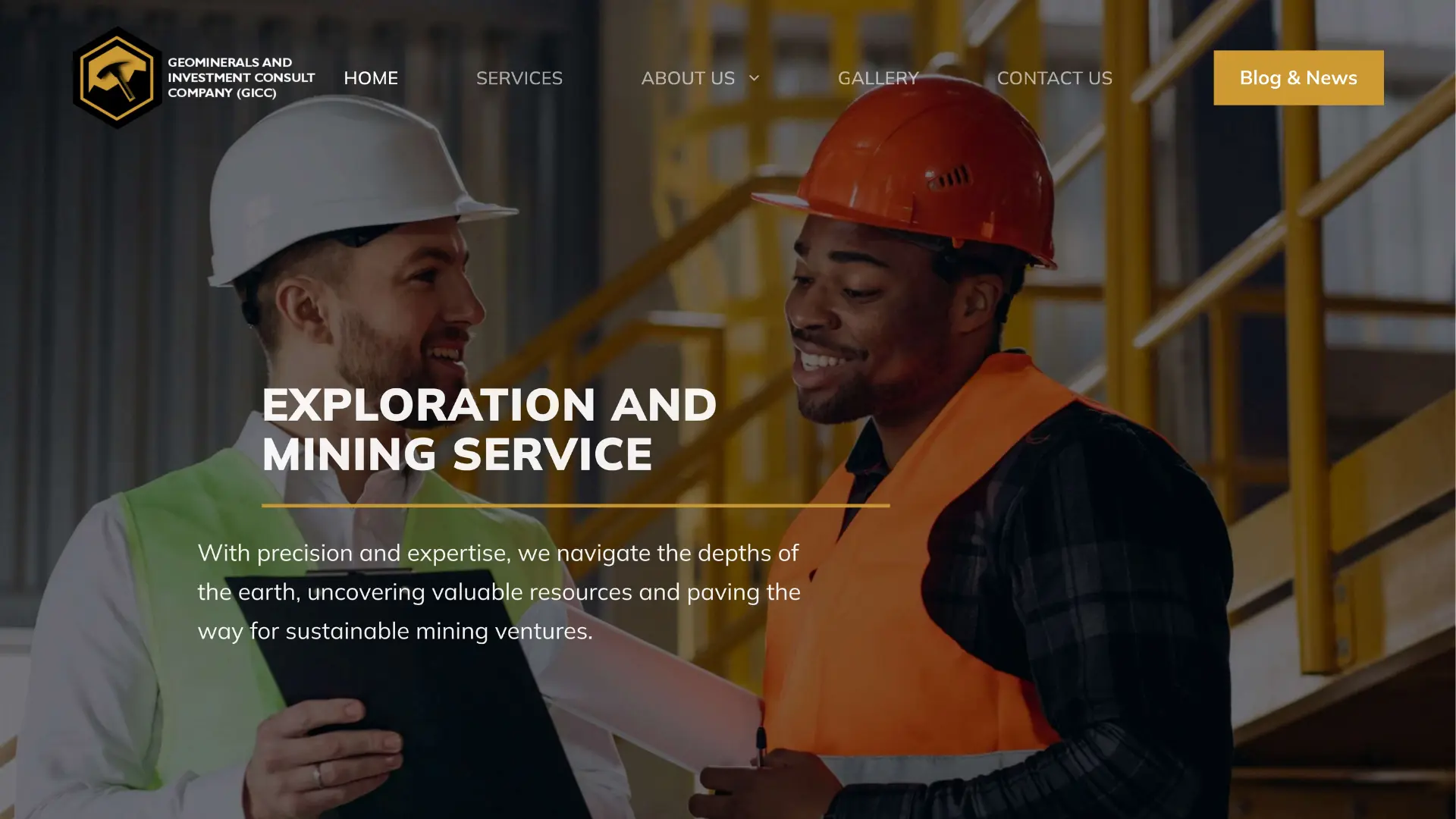
GICC is a mining and geological consultancy operating across Ghana and Sierra Leone, serving mining companies, investors and government stakeholders. They needed a site that read as credible to that audience — technical enough to be taken seriously, clear enough for a non-specialist investor to understand what they do. I took the project from Figma through to a fully built, self-manageable WordPress site: information architecture, visual system, page design, build, content structure and handover.
- Client
- Geominerals and Investment Consult Company (GICC) — Ghana & Sierra Leone
- Role
- Design & Build Lead — UI design (Figma), WordPress development, project management
- Year
- 2026
- Category
- Web Design & Development
- Tools
- Figma WordPress Elementor Adobe Photoshop Adobe Illustrator Yoast SEO Squoosh Google Analytics
01
Understanding the audience before the aesthetic
Discovery, structure and information architecture
GICC sells trust before it sells services. Their buyers are mining operators, investors and regulators — people who judge a firm on evidence, not decoration. So the first work wasn't visual. It was working out what a visitor needs to see, in what order, to believe this company can handle their project.
I mapped the site around three questions a prospect actually asks: what do you do, who are you, and can you prove it. That produced a lean architecture — Services, a nested About section (About GICC, Who We Are, Our Team), Gallery, Blog & News, and Contact — with the nesting used deliberately so the credibility pages sit together instead of competing for space in the main nav.
The homepage was then sequenced to answer those questions in the same order: capability statement, company background, services, partners, then live proof through recent news.
02
From Figma file to finished build
Design system, page design and front-end development
I designed the full site in Figma first type scale, colour, spacing, component states, and every page laid out at desktop and mobile before a single line went into WordPress. Working design-first meant decisions got argued and settled in the file, not mid-build, which kept the development phase fast and the outcome consistent.
The visual direction leans on the client's own field photography and a restrained gold-on-dark palette drawn from the existing logo, so the brand carried through rather than being replaced. Earth-tone imagery does the emotional work; the layout stays quiet and structured so the technical content reads easily.
I then built it in WordPress with Elementor, translating the Figma system into reusable global styles and section templates. Every element, nav behaviour, animated statistic counters, service cards, the partner strip, the news grid, was built to the design, then refined against it on real breakpoints rather than assumed to work.
03
Built to be run by the client
Content systems, performance and handover
A consultancy site is only as good as its last update. GICC publishes regularly, budget analysis, award announcements so the blog and gallery were set up as genuine content systems, not decorative sections. Posts pull automatically into the homepage news grid; the team can publish without touching layout and without breaking the design.
On the technical side: imagery served as compressed WebP, responsive image sizes generated at upload, SEO metadata and Open Graph cards configured so every page and post shares cleanly on LinkedIn and X — which matters, because that's where their audience is.
I closed the project with a handover: how to add a post, swap a team member, update the gallery, and keep image weight down. Two years on, the site is still being updated by the client without developer involvement — which was the point.